

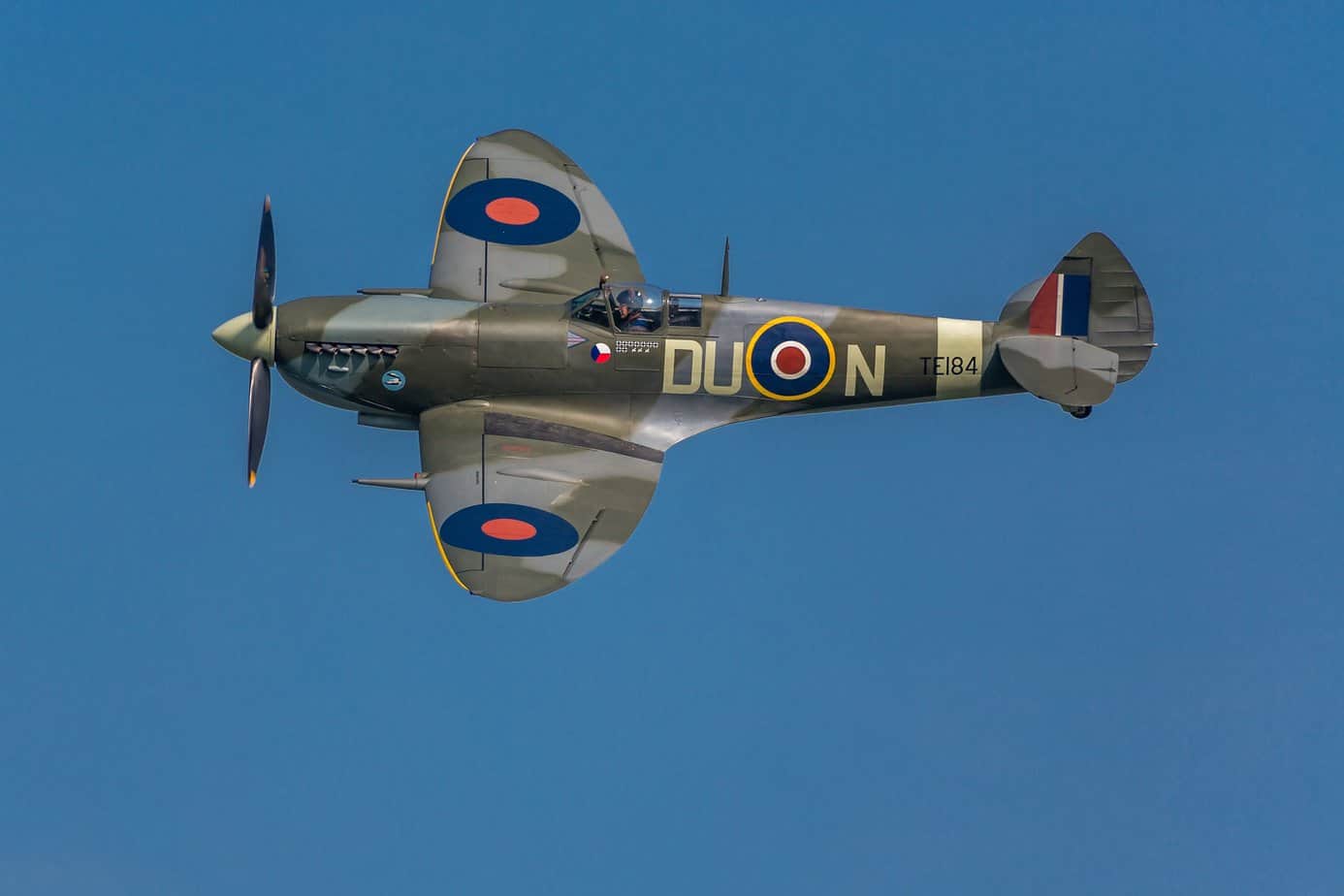
The Supermarine Spitfire is a British single-seat fighter aircraft that was used by the Royal Air Force and many other Allied countries during World War II. The Spitfire was designed by R. J. Mitchell, who began work on the design in 1934. The aircraft first flew in 1936 and entered service with the RAF in 1938.
One of the most iconic aircraft of the war, the Spitfire is perhaps best known for its role in the Battle of Britain, where it was instrumental in helping the RAF defeat the German Luftwaffe and secure control of the skies over Britain. The Spitfire’s agility, speed, and armament made it a formidable opponent in dogfight engagements, and it was able to hold its own against the more heavily armed German fighters, such as the Messerschmitt Bf 109.
The Spitfire was powered by a Rolls-Royce Merlin engine and was armed with eight .303 caliber machine guns. Later versions of the aircraft were fitted with more powerful engines and heavier armament, including cannons. The Spitfire was also used as a reconnaissance aircraft and a ground-attack aircraft, and it was also used to intercept V-1 flying bombs.
Throughout the war, the Spitfire was continuously upgraded and modified to keep pace with the changing demands of the battlefield. Over the course of its production, more than 20,000 Spitfires were built, and it served in various theaters of the war, including the Battle of Britain, the Battle of Malta, the Normandy invasion, and the Pacific War.
The Spitfire was not just a British aircraft, it was also used by many other Allied countries. The Spitfire was used by the Royal Canadian Air Force, the Royal Australian Air Force, and the Indian Air Force, among others. The aircraft was also used by the Free French Air Force and the Polish Air Force, which had a unit of Spitfires that fought in the Battle of Britain.
The Spitfire was not just a military aircraft, it was also a cultural icon. It symbolized the resilience and determination of the British people during the dark days of World War II. The Spitfire was featured in many films and documentaries, and it has been the subject of countless books and articles. Today, many Spitfires have been restored and are on display in museums and airshows around the world, where they continue to captivate audiences with their sleek lines and graceful flight.
The Spitfire is a true classic of aviation history. Its design was innovative, its performance was outstanding, and it played a critical role in the outcome of World War II. The Spitfire will always be remembered as one of the most iconic and beloved aircraft of all time.